
Hiring globally sounds exciting — until you actually try to make it happen.
The best candidate for your role might be sitting in Bangalore, San Francisco, or Tokyo. But hiring them isn’t just about finding great talent. It means dealing with labor laws you don’t fully understand, tax structures that work differently, mandatory benefits you didn’t know existed, and termination policies that aren’t flexible. None of these are optional. You can’t “figure it out later.”
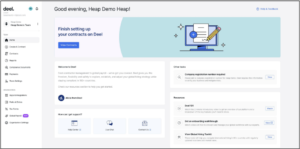
This is where the Employer of Record (EOR) model changes everything — and why platforms like Deel have quietly become essential for modern businesses hiring globally.
What is an Employer of Record (EOR)?
An Employer of Record is a third-party organization that legally employs workers on your behalf in other countries. You still manage the person day to day. They still work with your team. Nothing changes on the frontline.
What changes is everything happening in the background.
The EOR handles:
- Employment contracts aligned with local law
- Payroll paid in the employee’s currency
- Taxes, filings, and deductions
- Statutory benefits
- Compliance with local labor regulations
- Onboarding and offboarding processes
Instead of building all of this from scratch in every new country, you plug into a system that already exists. That is a bigger shift than it sounds.
Why EOR matters more than most companies realize?
If you have never hired internationally, it is easy to underestimate what is actually involved. Most companies assume the hardest part is finding the right person. It is not.
The hard part is everything that comes after.
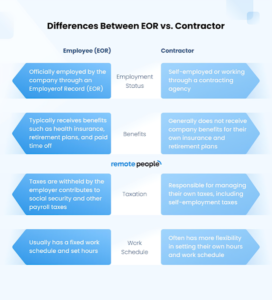
Say you want to hire someone in Germany or Brazil. Without an EOR, your options are limited to two paths—neither of them ideal.
Option 1: set up a legal entity
Setting up a legal entity in another country is slow, expensive, and paperwork-heavy. It can take months, especially if you are just testing the market.
Option 2: hire as an independent contractor
Hiring as a contractor seems easier at first. But contractor misclassification is a serious risk. If local authorities determine someone should have been classified as an employee, the consequences include penalties, back taxes, and legal liability.
EOR removes both of these problems entirely.
What actually changes when you use an Employer of Record?
The biggest difference is not operational — it is mental.
Without EOR, hiring internationally feels like a commitment. With EOR, it feels like an option. You stop asking, “Can we even hire in this country?” and start asking, “Is this the right person for the role?”
Faster hiring — days instead of months
Setting up a legal entity can take months. With an EOR, that timeline shrinks to days. In a competitive hiring market, that speed is a real advantage.
No more compliance guesswork
Most companies do not have in-house experts for every country they hire in. Without support, there is always a lingering question: “Are we doing this correctly?” EOR removes that uncertainty. Contracts follow local law. Payroll follows local regulations. Benefits are not guesswork.
Payroll without the headache
Paying someone in another country involves currency considerations, tax deductions, filing requirements, and compliance checks. EOR handles all of this in the background so salaries go out correctly and on time, without micromanagement.
Significantly reduced legal risk
Misclassifying employees as contractors is one of the most common and costly mistakes in global hiring. EOR ensures every hire is structured correctly from day one — removing the risk before it becomes a problem.
How Deel makes EOR work in practice?
There are multiple EOR providers in the market. Deel stands out in how it packages the experience. It does not feel like a legal service — it feels like a product.
Speed you can actually feel
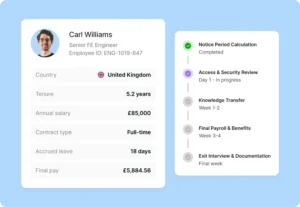
Deel moves fast in a way you notice while using it. You can hire someone, set them up, and arrange their equipment almost immediately. Order a laptop today, and in many cases it arrives within hours or the next day—meaning your new hire can log in and start work right away.
Everything in one place
Instead of managing contracts in one tool, payroll in another, and compliance somewhere else — Deel brings it all together. Hire, onboard, and pay within the same system. The reduction in friction is hard to appreciate until you have dealt with the alternative.
Compliance without the overwhelm
Deel handles the legal layer for you. You do not need to become an expert in labor laws across multiple countries. Contracts and processes are already aligned with local regulations — a major relief for smaller teams without dedicated HR or legal resources.
Built for how modern companies actually hire?
Most older HR systems are designed for single-country operations. Deel is built for remote teams, distributed hiring, and multi-country workforces — which is how the best companies operate today.
Limitations of EOR: what it does not solve
EOR solves a lot, but it is not a perfect solution for every situation.
Cost at scale — There is a monthly cost per employee. For small teams it feels reasonable, but as you grow, you will naturally start comparing EOR costs against the cost of setting up your own legal entities. That trade-off becomes a real conversation over time.
Not necessary for local hiring — If you are only hiring domestically, EOR adds little value. Its real strength shows when you are hiring across borders and need structure and compliance support.
Platform depth can feel overwhelming at first — Deel has evolved into a full workforce management platform. When you are just starting out, the feature depth can feel like more than you need. The upside is that you grow into it as your team scales.
The bigger shift: how global hiring is evolving
What is really happening here goes beyond EOR as a tool. It is about how hiring itself is changing.
A few years ago, companies were limited by geography. Today, they are limited by how well they can manage global complexity. Tools like Deel are steadily removing that complexity — which means companies are shifting from asking “where do we have an office?” to asking “where can we find the best talent?”
That is the real transformation.
Final thoughts
Employer of Record is not just simplifying global hiring — it is quietly redefining it. Once the barriers of compliance, payroll, and legal risk are removed, hiring becomes what it was always meant to be: finding the right person for the role, no matter where they are.
Frequently asked questions
- What does an Employer of Record actually do?
An EOR handles all the legal aspects of hiring someone in another country — contracts, payroll, taxes, and compliance. The company still manages the employee’s work as normal. - Is hiring really faster with an EOR?
Yes, significantly. Instead of waiting months to set up a legal entity abroad, you can typically onboard someone within days. It is not instant, but it is dramatically faster than the traditional route. - Does Deel help with equipment and onboarding?
Yes, and this surprises most people. You can arrange laptops and equipment directly through Deel, and they manage delivery. It makes the onboarding experience much smoother for remote employees. - How reliable is Deel for payroll?
Payroll is one of Deel’s strongest features. Payments go out on time in the correct currency, without requiring you to manage multiple systems or chase errors. - What is the difference between an EOR and a PEO?
An Employer of Record (EOR) takes on full legal liability as the employer in countries where you have no entity. A Professional Employer Organization (PEO) co-employs workers but typically requires you to already have a legal entity in that country. EOR is the better option for new markets. - When should a company stop using EOR and set up its own entity?
Most companies consider setting up a legal entity once they have 10 or more employees in a single country, or once EOR fees exceed the cost of maintaining a local entity. Below that threshold, EOR is almost always the more cost-effective choice.